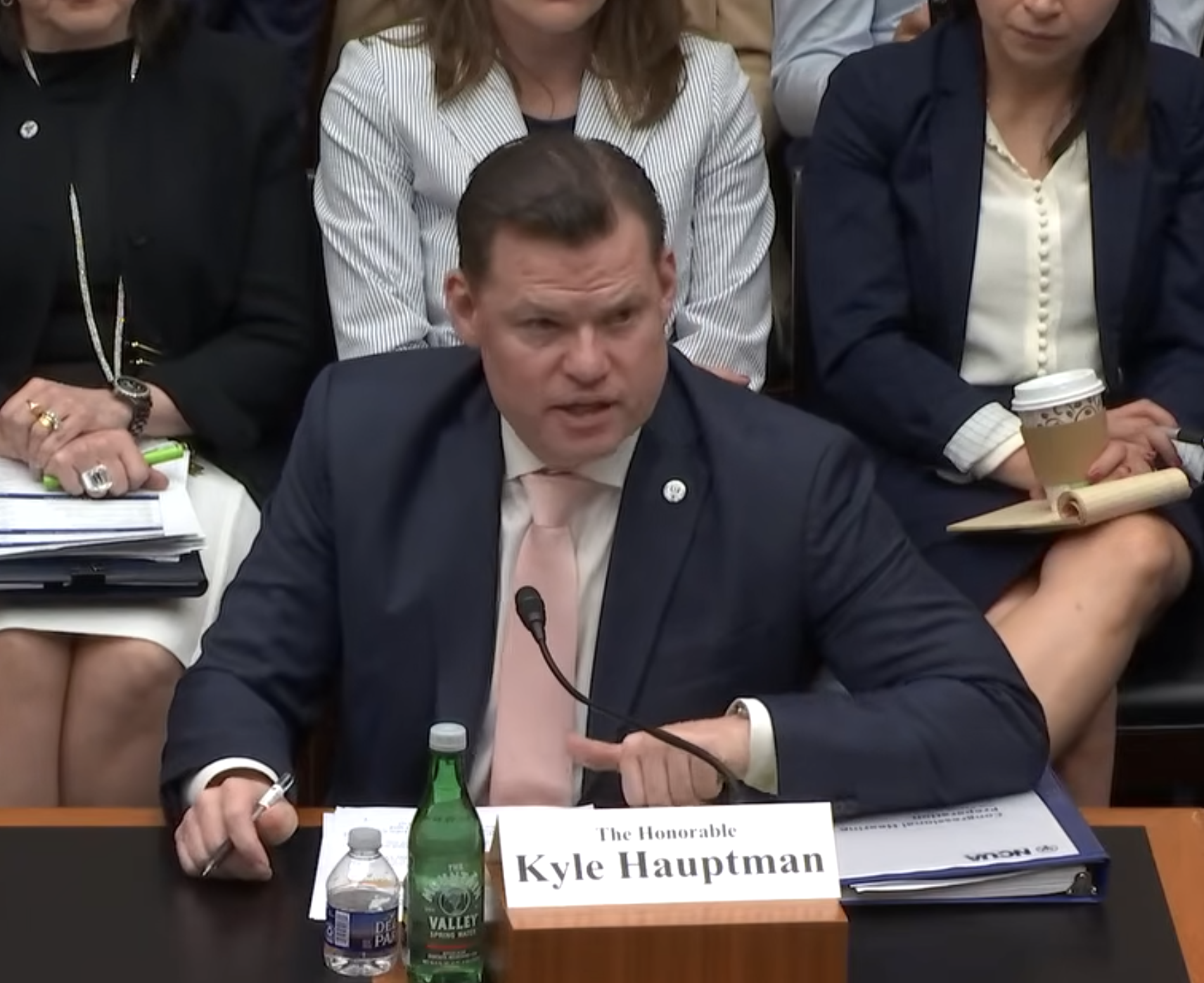
 NCUA Chairman Kyle Hauptman testifies during the U.S. House Financial Services Committee hearing on June 4, 2026.
NCUA Chairman Kyle Hauptman used what may be his final appearance before Congress to defend the agency's deregulatory agenda, promote stablecoin innovation and emphasize the importance of preserving smaller financial institutions.
Testifying Thursday before the House Financial Services Committee during a hearing on federal prudential regulators, Hauptman highlighted the health of the credit union system while outlining the NCUA's priorities as the agency prepares for a leadership transition.
Hauptman opened his remarks by congratulating Treasury official John Crews, whom President Trump recently nominated to succeed him on the NCUA Board.
"As the current Chair, I remain dedicated to serving in this role, and no other, until my successor is confirmed," Hauptman told lawmakers, describing Crews as "a seasoned and committed leader" with a track record of balancing innovation and safety.
A major focus of the testimony was the NCUA's implementation of the GENIUS Act and its proposed stablecoin framework. Hauptman argued that stablecoins could make payments "faster, cheaper and more inclusive" while helping maintain the U.S. dollar's global dominance. He noted that the agency's recently proposed stablecoin rule is designed to place credit unions "on equal footing with banks" as digital payments evolve.
Hauptman also pointed to the credit union system's strong financial condition. As of year-end 2025, federally insured credit unions held $2.4 trillion in assets, reported an aggregate net worth ratio of 11.26%, and served more than 145 million members. While loan delinquencies have increased and commercial real estate remains an area of concern, he said the overall system remains resilient.
The chairman also defended the agency's broader regulatory reforms, including its Deregulation Project and efforts to focus supervision on material financial risks. He noted that the NCUA has reduced its workforce by 23% through voluntary separations while continuing a broader organizational restructuring scheduled for completion by 2027.
Closing his remarks, Hauptman urged lawmakers to recognize the value of community-based credit unions and smaller financial institutions, arguing that regulatory requirements often fall disproportionately on smaller organizations.
"We're a better, more prosperous country because of the unique American financial system that still contains over 8,000 banks and credit unions," Hauptman said, warning against a future dominated by only a handful of large financial institutions.
© Arc, All Rights Reserved. Request academic re-use from www.copyright.com. All other uses, submit a request to TMSalesOperations@arc-network.com. For more information visit Asset & Logo Licensing.