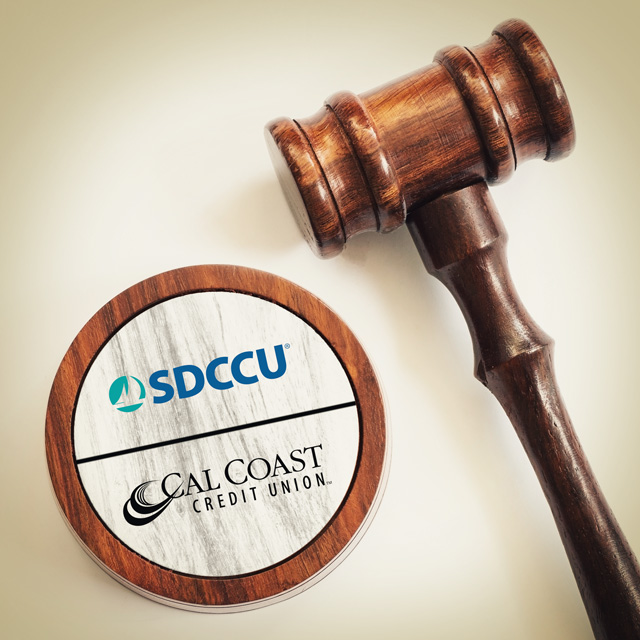
 SDCCU and Cal Coast legal battle.
Attorneys for the $9.3 billion San Diego County Federal Credit Union and the $3.4 billion Cal Coast Credit Union agreed to begin settlement negotiations in a dispute over a failed merger after a California judge denied a preliminary injunction that would have forced the consolidation.
In her ruling Thursday, California Superior Court Judge Carolyn M. Caietti in San Diego said the facts in this merger dispute do not support the issuance of a preliminary injunction, although she noted her decision to deny the injunction is not a final judgement.
On Friday, attorneys for both credit unions appeared for their first case management conference and jointly requested a continuance to allow time for settlement discussions.
"Your Honor, I believe both parties will make a great attempt to resolve this case," Cal Coast's attorney, Blair Connelly, said.
Caietti granted the continuance and scheduled the next conference for May 22.
Cal Coast had sought a preliminary injunction to prevent SDCCU from terminating a merger agreement based on what it said were manufactured excuses to re-trade its fundamental terms. SDCCU countered that the merger agreement permitted termination after discovering Cal Coast allegedly misrepresented its operations, violated multiple regulations and had widespread non-compliance issues. In March, the credit unions presented their arguments during a five-hour court hearing.
"We are extremely pleased with Judge Caietti's carefully reasoned decision denying the preliminary injunction. It affirms SDCCU's decision to terminate the merger agreement with Cal Coast and we believe signals the end of any merger between the two institutions," SDCCU's attorney, Mike Carlinsky, said. "We hope that the court's decision will persuade Cal Coast to drop its baseless litigation so that the parties can move on with their respective businesses."
Cal Coast expressed disappointment with the decision.
"We respect the Court and remain confident in the merits of our case," a Cal Coast spokesperson said. "As we evaluate the ruling, our top priority continues to be serving our members and maintaining full compliance with all applicable laws and regulations."
A central issue in the case was whether Cal Coast met the requirements for a preliminary injunction, which under California law requires the likelihood of success on the merits of Cal Coast's case and whether the balance of harms favored it.
Caietti found the credit union failed on both requirements.
Because Cal Coast was seeking a mandatory injunction, it would have compelled SDCCU to move ahead with the merger pending trial, which the court said is not permitted except in extreme cases. Even if Cal Coast had met the high burden to support a mandatory injunction, the credit unions did not secure the approval to merge from the NCUA.
After the federal agency conducted a merger review in October 2025, NCUA Regional Director Julie Cayse issued a three-page letter that identified multiple weaknesses in governance practices and strategic planning of the proposed consolidation. Because of these concerns outlined in a January letter, Cayse decided to defer her decision on whether to approve the merger.
"It is noteworthy the NCUA letter of January 27, 2026, identifies at lease some areas of concern which appear to form the basis by SDCCU to seek termination of the merger," Caietti wrote in her decision.
In balancing the harm requirement, the court found the harm to SDCCU would be greater than to Cal Coast. Caietti noted SDCCU would lose its operational autonomy, because the injunction would have required the credit union to obtain permission from Cal Coast before incurring unplanned expenses, hiring certain employees or adjusting operational policies. The judge concluded this would have greatly impaired SDCCU's ability to operate and govern itself.
Although Cal Coast argued that without the injunction it would lose a unique merger opportunity and suffer reputational harm, Caietti noted the credit union failed to address how this cannot be compensated monetarily, especially considering that the supplemental merger agreement specifically contracted for monetary damages to be awarded in the event of termination.
Additionally, Caietti also found that Cal Coast did not establish a likelihood of prevailing on its breach of contract claims against SDCCU.
"SDCCU's argument that there is an overall lack of compliance and lack of knowledge of the alleged compliance problems by Cal Coast, which is the primary material breach here, is persuasive," the court wrote.
It was during the merger's integration process that SDCCU grew concerned about Cal Coast's alleged lack of controls and non-compliance issues regarding its technology, auto and QCash loans. SDCCU also alleged Cal Coast had deficient policies for unfair, deceptive or abusive acts or practices.
"The overall evaluation of this evidence supports the conclusion that there was widespread institutional compliance issues and that Cal Coast failed to implement systems preventing discriminatory practices," Caietti wrote.
Peter Strozniak can be reached at peter.strozniak@arc-network.com.
© Arc, All Rights Reserved. Request academic re-use from www.copyright.com. All other uses, submit a request to TMSalesOperations@arc-network.com. For more information visit Asset & Logo Licensing.