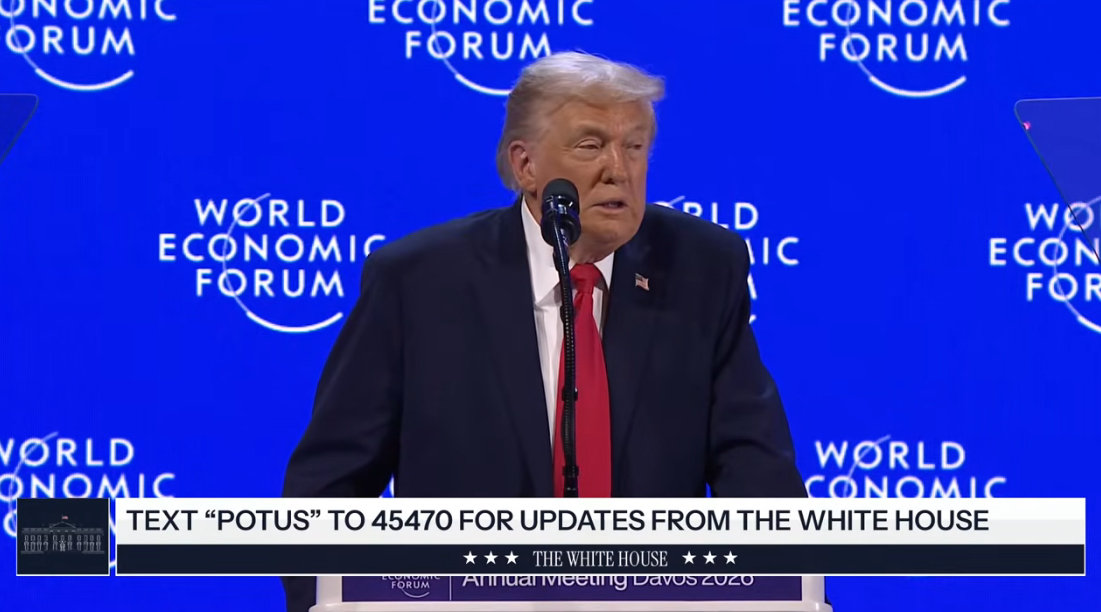
 President Trump speaking at the World Economic Forum in Davos, Switzerland Wednesday.
President Trump resurrected his plan for a 10% cap on credit card interest rates during his speech in Switzerland Wednesday, leading credit union trade groups to quickly issue statements opposing it.
Trump initially raised the issue in a tweet Jan. 13 as an edict for it to begin Jan. 20 and last one year. On Thursday, at the World Economic Forum in Davos, he phrased it as a plea for congressional action.
Trump’s comments on credit card rates accounted for about 120 words of an 11,000-word speech that lasted for more than one hour, covering topics from America’s need to take ownership of Greenland to French President Emmanuel Macron’s sunglasses.
It followed his comments about the need to restrict corporate investors buying residential houses and difficulties Americans face in buying a home:
“One of the biggest barriers to saving for a down payment has been surging credit card debt. The profit margin for credit card companies now exceeds 50% — one of the biggest. And they charge Americans interest rates of 28%, 30%, 31%, 32%. What ever happened to usury?
“So to help our citizens recover from the Biden disaster, all caused by this horrible, just horrible precedent, I’m asking Congress to cap credit card interest rates at 10% for one year. And this will help millions of Americans save for a home. They have no idea they’re paying 28%. They go out they're a little late in their payment, and they end up losing their house. It’s terrible.”
Both America’s Credit Unions (AmCU) and the Defense Credit Union Council (DCUC) quickly responded.
AmCU President/CEO Scott Simpson said the group supports Trump’s goal to reduce costs for households, but said a 10% interest rate cap “would have the opposite effect on affordability for many consumers.”
“Experience shows that rigid and arbitrary rate caps do not lower costs, they restrict access to affordable products for families who need them the most,” Simpson said.
Jason Stverak, DCUC’s chief advocacy officer, said a blanket 10% rate ceiling would harm military families and working Americans by reducing access to responsible credit and produce other unintended consequences.
“A rigid federal cap would likely reduce access to credit by limiting credit unions’ ability to serve higher-risk borrowers,” Stverak explained. “Many credit unions would be forced to tighten underwriting standards or scale back credit card and small-dollar lending altogether,” Stverak said.
“That outcome would disproportionately affect young service members, junior enlisted personnel and lower-income members who do not yet have prime credit profiles,” he said.
Trump’s proposal would cut rates further than a bill introduced a year ago by Sens. Josh Hawley (R-Mo.) and Bernie Sanders (D-Vt.) that would have capped rates at 18%. That bill died in committee.
The NCUA already limits interest rates to 18% for federal credit unions.
Contact Jim DuPlessis at Jim.DuPlessis@arc-network.com.
© Arc, All Rights Reserved. Request academic re-use from www.copyright.com. All other uses, submit a request to TMSalesOperations@arc-network.com. For more information visit Asset & Logo Licensing.