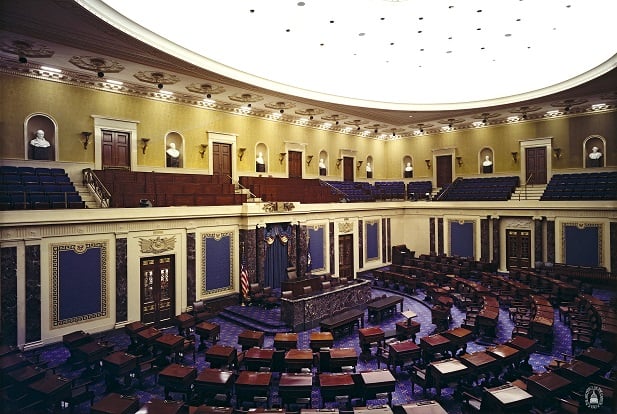
 U.S. Senate Chamber. Credit: Architect of the Capitol.
The U.S. Senate has passed the fiscal year 2026 National Defense Authorization Act, sending the annual defense policy bill to the President for signature after the House approved the measure last week.
The Defense Credit Union Council (DCUC) praised both chambers for advancing the NDAA without including the Credit Card Competition Act or the Durbin–Marshall credit card interchange amendments, provisions the organization has long opposed. DCUC said their exclusion helps protect the financial stability of military members and veterans who rely on credit unions serving defense communities.
DCUC and America's Credit Unions commended Congress for advancing the National Defense Authorization Act without any Credit Card Competition Act (CCCA) language or Durbin–Marshall amendments.
DCUC also acknowledged efforts by Sens. Alex Padilla, (D-Calif.) and Kevin Cramer, (R-N.D.) to include provisions related to the Central Liquidity Facility, a key emergency funding backstop for credit unions. While those measures did not make it into the final bill, DCUC said the advocacy effort will continue.
“We extend our sincere appreciation to Senators Alex Padilla and Kevin Cramer for their leadership in proposing the inclusion of Central Liquidity Facility (CLF) provisions,” Jason Stverak, DCUC's chief advocacy officer, said. “Although these measures were not incorporated in the final bill, DCUC looks forward to continuing its work with both congressional leaders.”
Looking ahead, DCUC said it is encouraged by signs that future defense bills may place increased emphasis on veteran-focused initiatives. As the FY2026 NDAA advances, the organization said it is already preparing to lean into veteran-centered policies during future NDAA markups, negotiations and broader congressional discussions.
© Arc, All Rights Reserved. Request academic re-use from www.copyright.com. All other uses, submit a request to TMSalesOperations@arc-network.com. For more information visit Asset & Logo Licensing.